23-Jun-2026
A common hallmark of cancer cells is unregulated cell division. One protein thought to be behind this is Aurora A, a kinase responsible for driving cell division which is frequently overexpressed in breast cancer. Despite this clear link, therapies targeting Aurora-A have failed to deliver results beyond the preclinical stage and are often associated with off-target effects. However, that may be about to change, thanks to a team of researchers based at several institutes in Italy.
So far, inhibitors targeting Aurora-A have been designed to bind to the protein by competing with ATP, which is required for its kinase activity. However, since ATP-binding sites are present in all kinases, this approach has resulted in inhibitors with low specificity for Aurora-A over other kinases, leading to off-target effects. The research team sought to overcome this by designing inhibitors to target Aurora-A in a different way. Specifically, they looked at interfering with the interaction between Aurora A and TPX2 - a protein required for Aurora-A activity and which is also overexpressed in breast cancer.
The research team started by screening a library of more than 5 million compounds using computer simulations. After multiple rounds of simulations, they eventually settled on 15 compounds to investigate in the lab via Native Mass Spectrometry “competition experiments”. These experiments tested the 15 potential compounds for their ability to interrupt the binding of a TPX2 peptide fragment to the catalytic domain of Aurora-A.
Of the 15, one compound was a clear winner: ACT12. ACT12 showed strong ability to disrupt Aurora A binding to TPX2, and crucially did not bind to the ATP-binding pocket of Aurora A. This makes it likely that the compound will not cause the same off-target effects as previous Aurora A-targeted therapies.
The next step was to test ACT12 in breast cancer cell lines and mammospheres – these are 3D cell culture models made from breast cancer cells. Treatment with ACT12 reduced the number of breast cancer cells that were dividing and caused cell death or senescence.
In the final stage, ACT12 was tested on patient-derived organoids. Specifically, organoids were derived from patients with triple-negative breast cancer, a notoriously aggressive form of breast cancer for which few therapies exist. These patients had been unresponsive to chemotherapy, the main form of treatment for triple-negative breast cancer. All three patient-derived organoids responded to treatment with ACT12. This suggests that targeting the Aurora A-TPX2 interaction represents a promising strategy for treatment of breast cancer, particularly in settings where other treatment options are not available or not effective, such as triple-negative breast cancer.
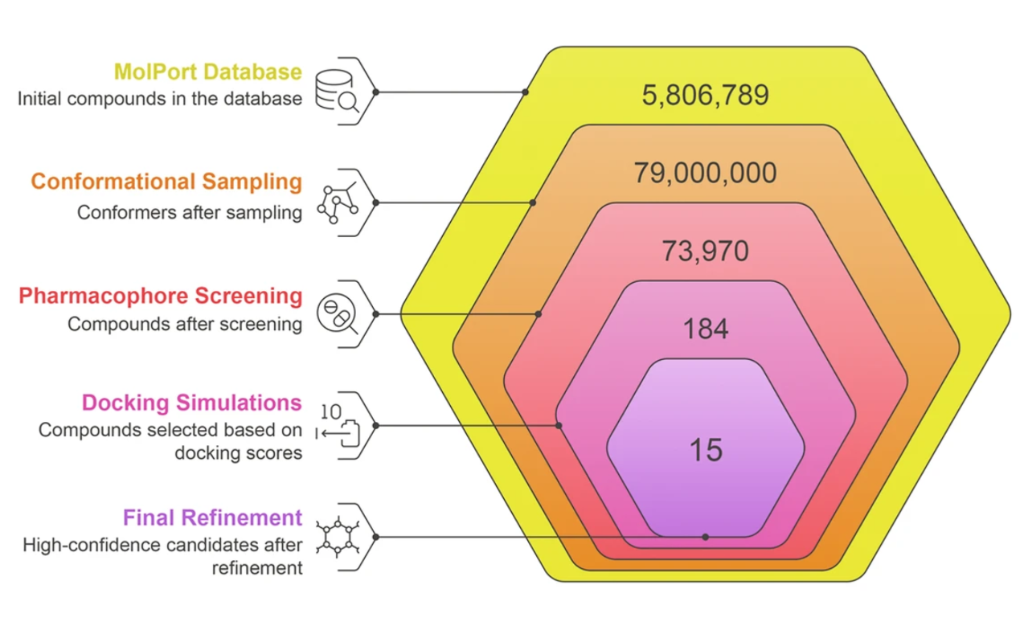
Figure 1 – Overview of the drug discovery process used. The team started with a database of more than 5 million compounds, then eventually narrowed this down to 15, of which ACT12 was the most promising option.
“This work was supported by ITACA.SB project. In particular, Surface Plasmon Resonance experiments that have been crucial in confirming the good binding affinity between ATC12 and Aurora-A were performed using equipment for biochemistry purchased thanks to ITACA.SB/Instruct-ERIC funding.
This research shows how shows how multidisciplinary approaches going from bioinformatics to biochemistry and advanced cell biology can be integrated together to support drug development.”
- Said Italia Anna Asteriti, one of the lead researchers on the study.
The full team of researchers includes: Dalila Boi, Giulia Fianco, Federica Polverino, Francesco Fiorentino, Anna Mastrangelo, Simone Rossi, Elisabetta Rubini, Serena Rosignoli, Francesca Troilo, Maria Rosaria Antonelli, Dalila Tarquini, Laura Cervoni, Serena Rinaldo, Angela Tramonti, Eleonora Kristina Scarpone, Chiara Naro, Claudio Sette, Venturina Stagni, Gianni Colotti, Dante Rotili, Alessandro Paiardini, Giulia Guarguaglini, and Italia Anna Asteriti.
The team of researchers was split between Sapienza University of Rome, the University of Modena and Reggio Emilia, the IRCCS Fondazione Policlinico A. Gemelli, the Catholic University of the Sacred Heart, the Fondazione Santa Lucia, Roma Tre University, the Biostructures and Biosystems National Institute, and the National Research Council of Italy.
You can read the full paper “The ATC12 small molecule inhibits the Aurora-A/TPX2 interaction and impairs the proliferation of breast cancer cells, published in Cell Death and Disease here. The work was supported by funding from several projects, including Potentiating the Italian Capacity for Structural Biology Services in Instruct-ERIC ("ITACA.SB"). If you have used Instruct-ERIC infrastructure to collect data for a manuscript and would like to have it published as a Science Highlight, then please get in touch with us!