

We have applied some changes to ARIA and are monitoring stability, but you can continue to work as normal. We appreciate your understanding.
05-Feb-2026
Over the last two decades the HADDOCK platform, developed and maintained by the Bonvin lab at the University of Utrecht, has proven to be a key computational resource for the investigation of biomolecular interactions. HADDOCK, which stands for High Ambiguity Driven protein-protein DOCKing, can incorporate a variety of experimental data (e.g. NMR chemical shift perturbations) into distance restraints to enable users to investigate an array of different biomolecular interactions. HADDOCK3 marks the latest iteration of the platform and provides researchers with the most flexible and modular version of the software yet, allowing them to set up fully customisable pipelines adapted to their own research questions.
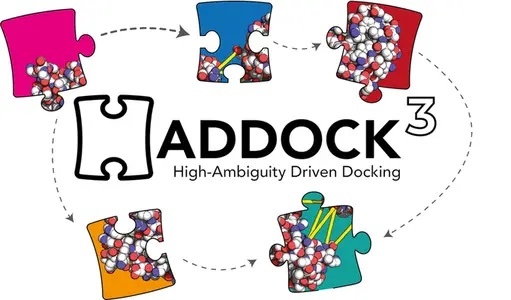
Image courtesy of Bonvin Lab – “A brief introduction to HADDOCK3”
What’s new?
Previous iterations of HADDOCK, such as the HADDOCK2.X series, enabled users to access a highly parameterisable linear pipeline. Broadly speaking, in HADDOCK 2 data is plugged in on one end by the user, with results then provided by the platform. In HADDOCK3, the pipeline is adapted into interchangeable modules which users can assemble into many forms in order to optimise their workflow. You can read more on the modularity available in HADDOCK 3 in the user manual, available here.
In HADDOCK 3 users are now able to:
HADDOCK3 also provides users with more of a holistic overview of their virtual experiments as they run by exposing intermediate structures and displaying decision points between stages in the workflow. This improved visualisation enables users to assess the quality of their pipelines, spot potential areas requiring optimisation, and then modify relevant parameters (or the workflow itself) to achieve more accurate results. HADDOCK3 tutorials can be found here.
What does this mean for users?
Rapid responses to new developments (or new research problems) are important for bringing about significant advancements in science. The modular nature of HADDOCK3 fosters collaboration by enabling researchers to publish and share their own custom modules which can be plugged in to the workflows of other researchers. Similarly, whilst not all datatypes are currently eligible for inclusion as inputs within HADDOCK3, as the platform undergoes further development they can be made eligible without rewriting the underlying software. Finally, researchers who can align the methods by which they investigate their docking queries with their own specific research question are more likely to produce accurate predictions. That the modular nature of HADDOCK3 allows and encourages this means the quality of research output enabled by the platform will also increase,
You can access the HADDOCK2.4 webserver here, and find more information, including instructions for installing HADDOCK3, via the user manual.
Do you want to contribute to HADDOCK3’s development? Visit its GitHub repository. A Jupyter notebook for antibody-antigen docking running on Google Colab resources is available from the HADDOCK3 Git repo.


