
We have applied some changes to ARIA and are monitoring stability, but you can continue to work as normal. We appreciate your understanding.
View All Magnetic Resonance Techniques at Instruct
The “Manuel Rico” NMR Laboratory (LMR) is dedicated to advancing structural research in Europe by providing access to cutting-edge technologies and essential technical support. The LMR specializes in state-of-the-art NMR spectroscopy, offering services such as spectra acquisition, biomolecular interaction analysis, and spectra assignment. With extensive experience in determining the structures of proteins, nucleic acids, and their complexes, the LMR has contributed around 200 entries to the Protein Data Bank (PDB). The laboratory is particularly renowned for its expertise in studying highly dynamic biomolecules, such as nucleic acids, peptides, and intrinsically disordered proteins, using liquid-state NMR techniques.
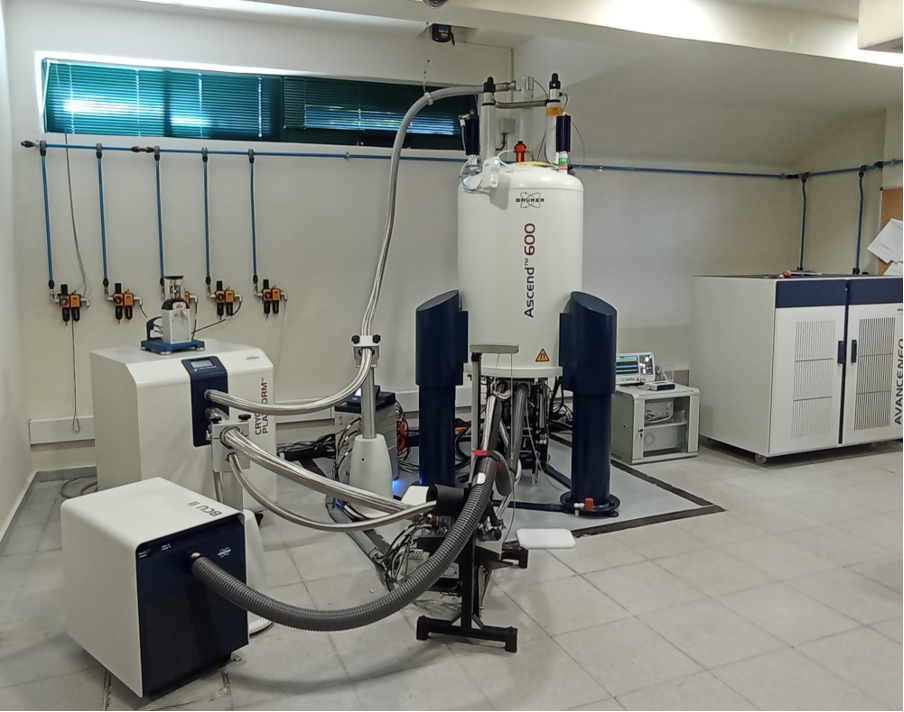
The LMR has recently expanded its capabilities with the installation of a novel biosolid NMR spectrometer equipped with a first-generation CPMAS CryoProbe. This addition creates a unique opportunity to combine liquid- and solid-state NMR methodologies within a single facility for the comprehensive study of complex biomolecular systems.
Cryoprobes have revolutionized liquid-state NMR spectroscopy by dramatically improving sensitivity through the reduction of thermal noise achieved by cooling detection electronics to cryogenic temperatures. The new CPMAS CryoProbe extends this technological breakthrough to solid-state NMR, increasing sensitivity by 3–4-fold in heteronuclear-detected experiments. This innovation enables time-efficient multidimensional experiments and facilitates the study of challenging biological systems at physiological temperatures without altering sample composition. Particularly beneficial for diluted samples, low-labeled systems, or naturally abundant molecules, this technology significantly broadens the scope of solid-state NMR applications.
Notably, the LMR is one of only two academic laboratories worldwide to possess this rare CPMAS CryoProbe. This strategic resource is positioning the LMR at the forefront of structural biology research and enabling studies previously considered unfeasible.
Solid-state NMR spectroscopy at LMR enables the investigation of a wide range of biological solids, including microcrystalline proteins, amyloids, fibrils, and sedimented solutes. Through direct heteronuclear detection, using either unlabeled or 13C–15N isotopically labeled samples, users can perform resonance assignments, determine structural restraints, and explore local molecular dynamics.
Support offered:
The provided support may cover all stages of the experimental workflow, including sample preparation, instrument setup, data acquisition, and analysis. The level of assistance and supervision will be tailored to the expertise of the visiting researcher.
Before the visit
Before your visit, please contact the facility staff to discuss your experimental plan and coordinate the logistics. This ensures that your access request matches the scientific goals of your project.
A typical visit includes about one week of instrument time and can take place either on-site or remotely by sending your samples. For complex experiments or users requiring additional support, extended access—up to several weeks—can be arranged upon request.
For more information, please visit the website of the LMR facility at the CSIC.