
We have applied some changes to ARIA and are monitoring stability, but you can continue to work as normal. We appreciate your understanding.
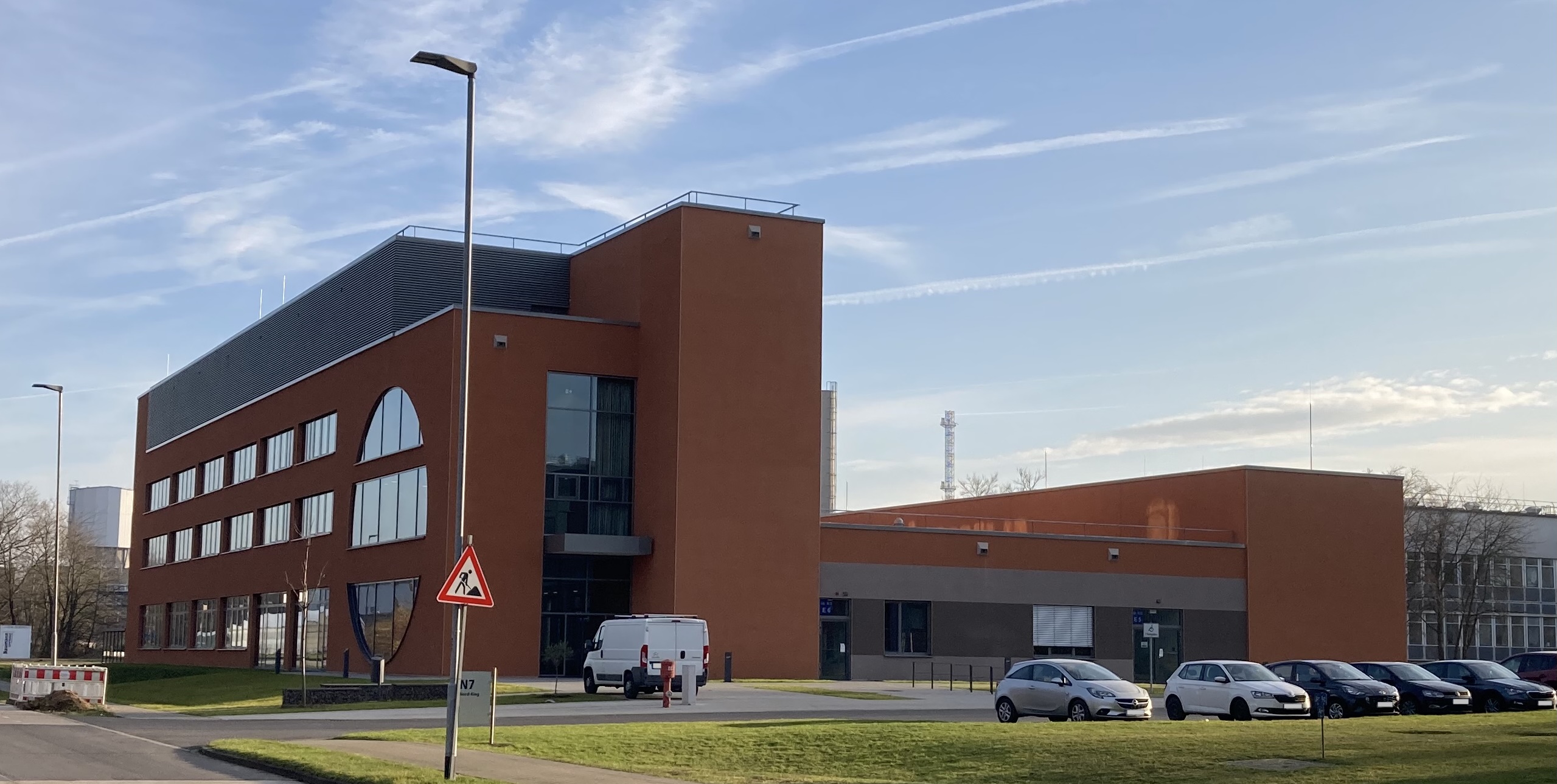
The cryoEM facility of the ER-C is situated on the campus of the Forschungszentrum Jülich, a major interdisciplinary research centre and member of the Helmholtz Association. With state-of-the-art equipment, like the Titan Krios G4 (TFS), the facility is specialised in cryoEM sample preparation and imaging of SPA- or cryoET- projects of biological specimen.
Collection of tilt series on the 300keV Titan Krios G4. 2 pre-screened grids will be loaded by staff scientists and initial atlas / overviews are collected. Based on this, regions of interest are selected and tilt series for an automatic overnight collection are set up. The collected tilt series are transferred via cloud link. Remote shadowing / access is possible.
Cells vitrified on grids can be loaded by facility staff scientists into our Aquilos 2 system. Based on a taken atlas / overview possible milling positions can be selected and an automatic milling performed. Present fluorescence markers can be used for a guided approach leading toward the correlative CLEM. Final grids are shipped back to user. Remote shadowing / access is possible
The ER-C offers a 24-hour data collection on the 300keV Titan Krios G4. Pre-screened sample will be loaded by staff scientists to the microscope. An initial atlas / overview of the grid will be taken and based on this, regions of interest selected. After complete setup a >16h automatic collection will be started. The collected images are transferred via cloud link. Remote shadowing / access is possible.
A vitrification session for one purified sample on ~4 grids with the Vitrobot (TFS) or EM GP2 (Leica) with subsequent clipping and screening session on the 200keV Talos Arctica G2. An initial atlas / overview of the grid and high-resolution images in up to three regions of interest will be taken to judge the sample quality. After quick setup a small, automatic dataset can be collected. The collected images are transferred via cloud link. Remote shadowing / access is possible.
Titan Krios G4 (TFS): A 300keV (x-FEG) TEM equipped with a Biocontinuum energy filter and K3 (both GATAN) direct electron detector combination. This allows data acquisition for single particle projects with up to 500 images per hour in faster acquisition / AFIS or tomograms with a rate of 2 per hour.
Talos Arctica G2 (TFS): A 200keV (x-FEG) TEM equipped with a Bioquantum energy filter and K3 (both GATAN) direct electron detector combination. This allows data acquisition for single particle projects with up to 300 images per hour in faster acquisition / AFIS.
Aquilos 2 (TFS): Dual beam SEM with gallium ion source. Capable of milling ~30 150-300nm lamellae overnight. Around 15 Lamellae can be milled, if a fluorescence guided CLEM workflow, using the in-column fluorescence METEOR (Delmic) camera, is used.
EM GP2 (LEICA) / Vitrobot (TFS): Plunge freezing devices with one, backside or double-sided blotting capabilities, respectively. Grid preparations of usually around 4 grids in liquid Ethane with subsequent clipping, to prepare them for TFS Autoloader systems, is performed.
The ER-C is offering access to cryoEM services and methods for the entire scientific INSTRUCT-ERIC community. Technical feasibility and details of the workflow can be discussed before project submission by contacting er-c@fz-juelich.de.
20µL of a 05.-2mg/mL purified protein sample is applied to standard grids using the plunge freezing method. After subsequent stabilising during clipping the grids will be loaded into the screening microscope Talos Arctica (200keV). After initial mapping of the grids detailed screening images up to high resolution (0.41Å pixel size) can be taken. Upon finding a good condition an initial dataset of 500-3000 images could be collected. Data is usually shared via cloud storage (NextCloud).
Good, pre-screened grids can be loaded to the Titan Krios (300keV). Here a fully automated data acquisition for SPA (usually 0.41Å pixel size) or cryoET / CLEM (usually 1.3Å pixel size) can be set up. About 7000 images or 50 tilt series can be collected this way in one overnight session. Data is usually shared via cloud storage (NextCloud).
Two pre-screened grids with a bacterial “carpet” or spaced-out adhered cells can be loaded into the Aquilos 2 FIB-SEM. Based on initial mapping and if possible, fluorescence guided targets can be defined. In an automated overnight session about 30 lamellae with 150-300nm thickness can be prepared.
Additional information can be found on er-c.org.